

If you're planning an artificial grass project, you may need to request quotes and samples from a few suppliers, and you'll then come across various technical terms on the specification sheet or on the sample labels.
These specifications largely determine the quality (including lifespan and performance) and the cost of artificial grass. In most cases you can choose the right products by following the supplier's recommendations. But if you want to go deeper, you need to understand what these specifications mean.
In this article, we'll explain what the main specifications mean.
Pile height
The height of the pile (the blade, fibre or yarn above the artificial grass backing), usually measured in millimetres (mm).
Dtex
A unit of measurement that indicates the linear mass of yarn in grams per 10,000 metres. In other words, it refers to the weight of the yarn used to make the artificial grass (at a given density). If all other specifications are the same, a higher Dtex means a higher face weight (more yarn in the grass), greater durability and a denser feel.
For example, 11000 Dtex means that 10,000 metres of yarn (yarns from the same stitch) weigh 11,000 g.
Note: Dtex is one of the main factors affecting the face weight of artificial grass. In general, more face weight = more material = higher price. We always state the exact Dtex (±5%), but some suppliers on the market exaggerate the Dtex on their quotes, and you can't detect this without checking with professional equipment.
Gauge
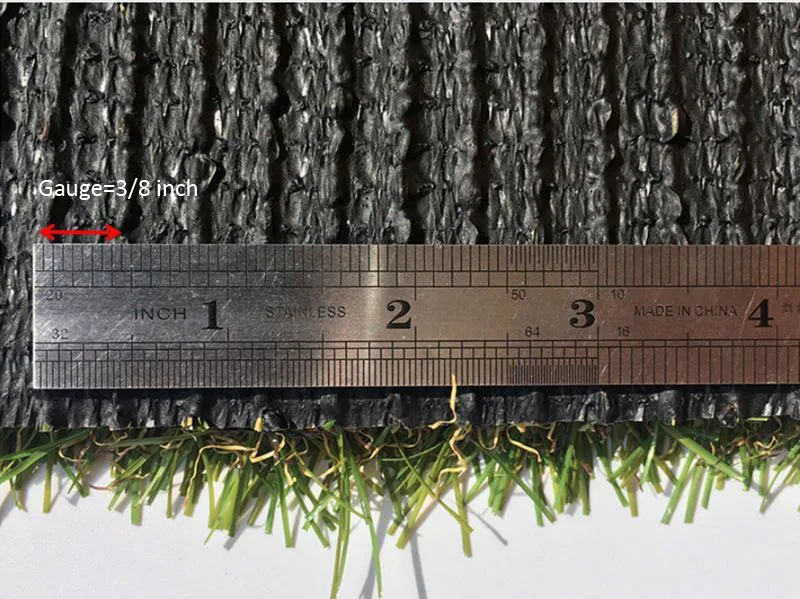
The distance between two adjacent rows, usually measured in inches.
Common gauges include 3/8 inch, 3/4 inch, 5/8 inch, 5/32 inch...
The gauge in the image below is 3/8 inch. 3/8 inch = 0.9525 cm, so there are 105 rows of grass over 100 cm (100/0.9525 = 105 rows)
Stitch rate
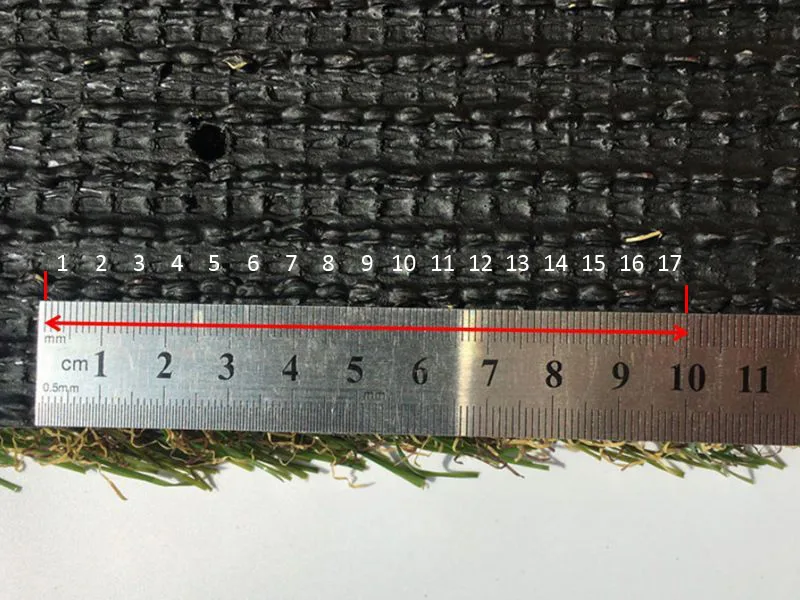
The number of artificial grass stitches per 100 cm along the stitch line.
In the image below there are 17 stitches in 10 cm, so there should be 170 stitches in 100 cm.
Density
The number of stitches per square metre (we don't list density on the latest version of the label, as it can be calculated from the gauge and stitch rate).
How do you calculate density from the gauge and stitch rate?
Take a gauge of 3/8 inch and a stitch rate of 170 stitches/100 cm as an example:
1) 3/8 inch = 0.9525 cm, so there are 105 rows over 100 cm (100/0.9525 = 105 rows).
2) Along the stitch line, there are 170 stitches over 100 cm (see the image below: stitch rate).
3) In one square metre (100 cm x 100 cm), there are 105*170 = 17850 stitches. We say the density of this artificial grass is 17850 stitches/m2.
Pile height, Dtex, gauge and stitch rate determine the face weight of artificial grass (gauge and stitch rate set the stitch density, so we sometimes also say that pile height, Dtex and stitch density determine face weight: it amounts to the same thing). We don't currently print face weight on our sample labels, but if you need it you can check with us once you receive the samples.
Backing
Artificial grass backing consists of a primary backing and a secondary backing. Together they give the whole system dimensional stability.
– The primary backing is made of woven polypropylene fabrics that let the artificial grass fibres be tufted into the material in rows and make it easier to seam artificial grass panels together.
Currently, all the products you have ordered use PP+NET as the primary backing (one layer of polypropylene (PP) fabric and one layer of mesh). The images are as follows:
– The secondary backing is often called the "coating" and is applied to the underside of the primary backing to permanently lock the tufted fibres in place.
SBR latex coating and polyurethane (PU) coating are two common coatings for artificial grass (most grass on the market today uses latex coating). Polyurethane coating is better but much more expensive. Latex coating is enough in most cases.